


A Fort Wayne Defender Community & Culture feature. 15 min read.
There is a building on Ardmore Avenue on Fort Wayne’s southwest side that most people drive past without a second look. It sits behind a set of fields, unassuming, the kind of place you’d mistake for an American Legion post or a bingo hall where someone’s running a fish fry. The sign out front reads Fort Wayne Sport Club. Founded 1927.
Nearly a hundred years ago, German immigrants gathered on those grounds and did something that still hasn’t fully registered in Fort Wayne’s collective memory: they made this a soccer city. Not with a stadium or a broadcast deal or a Hall of Famer on the ownership papers. With cleats, a pitch, and the stubborn belief that the sport they loved deserved a home in northeast Indiana.
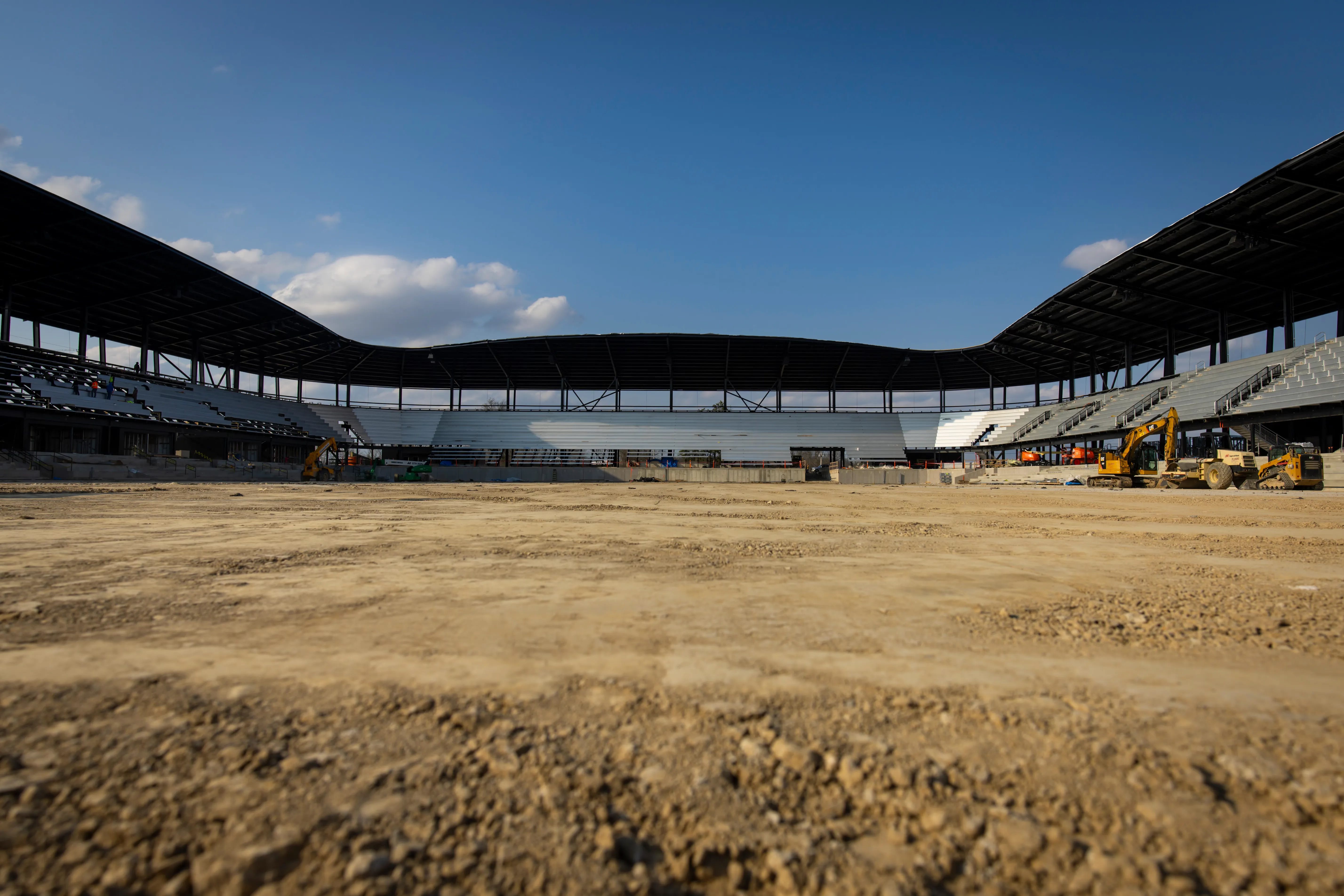
On May 2, 2026, Fort Wayne Football Club will play its first professional home match at Ruoff Mortgage Stadium, a 9,200-seat, privately funded soccer-specific stadium off Bass Road at I-69. It will be the largest outdoor venue in northeast Indiana. It’s the kind of building that sends a statement: Fort Wayne soccer has arrived.
But the moment didn’t arrive out of nowhere. It was carried here by immigrant families and volunteer coaches, by kids chasing a ball at The Plex on a January night, by parents who never missed a Saturday morning, and by a group of founders who believed this city deserved a professional club. Fort Wayne’s soccer history is older, deeper, and more human than any headline can capture.
From a clubhouse to a stadium, from 1927 to the first whistle in 2026. This story is a reflection of the passionate, hardworking and determined people of our community. This is a story about us, about our soccer city.
Ardmore Avenue
The Fort Wayne Sport Club started the way most important things start in the Midwest, with a little kick, and a group of people who refused to wait.
German immigrants founded FWSC in March 1927 to “promote soccer football and German culture.” They were factory workers from General Electric, the Pennsylvania Railroad, and International Harvester who’d been fielding their own teams and wanted something more. For four years they played on company fields across the city. In 1931, they purchased four and a half acres on Ardmore Avenue and built a clubhouse. Over the decades, the club grew to represent more than 30 nationalities. The fields on Ardmore became a gathering point for families who carried the sport with them from countries where it needed no explanation.
FWSC introduced youth soccer to Fort Wayne through the Catholic Youth League, years before travel soccer existed as a concept. They ran rec programs, competitive teams, and adult leagues. They hosted tournaments. They did the thankless organizational work that builds a sport from the ground up in a city that already had its loyalties spoken for. Hockey and basketball had the Coliseum, and American football owned the high schools.
What FWSC built was a foundation. Not a brand or a business model, but a community. A place where a kid could learn the game, where a parent who’d grown up with soccer in Mexico or Germany or Nigeria could coach without having to explain why the sport mattered. That foundation is still there. FWSC still runs youth programs today, nearly a century later. The fields on Ardmore are regularly used.
This founding identity, built by immigrants, has found a way to stay true even today. When a brand new face arrives in Fort Wayne from a different part of the world, looking to find a bit of normalcy to their new life, they look for familiarity, a sense of belonging. There’s comfort in this sport, a bit of home. When you ask around town, looking for that familiar sport, you hear the name Sport Club. That name means something.
Within the immigrant community, Sport Club feels like home. And it shows up not only on the field, but on heritage nights, where the soccer community gathers to socialize, share stories and the best part, the food from all parts of the world, which creates an experience unlike anywhere off the pitch. It’s a little reminder of home, shared with the community.
The Flames and the Spark
Professional soccer in Fort Wayne started a little earlier than some remember. The North American Soccer League put the sport on American television for the first time in the 1970s, and even after the league folded in 1984, the exposure left a mark. Kids who’d watched Pelé and Beckenbauer on TV grew up and put their kids in cleats. The catalyst in Fort Wayne? The 1986 Flames. The city’s first professional soccer team didn’t just put the indoor sport in the Coliseum. It ignited and fueled the next decades of growth in Fort Wayne. And when the ‘94 World Cup came to the United States, suddenly the best players on earth were on prime time in American living rooms. That kind of visibility doesn’t come around often, and it trickled into every youth soccer registration list in the country, Fort Wayne included.
Bobby Poursanidis had played professionally for seven years after an All-American career at LaSalle University, including stints with the Fort Wayne Flames in the American Indoor Soccer Association, the Indiana Kick, and Iraklis in Greece’s first division. When he settled in Fort Wayne, he didn’t retire from the sport. He rebuilt it from the youth level up.
He wasn’t alone. Bronn Pfeiffer, a Wayne High School product and Fort Wayne Hall of Fame inductee, played alongside Poursanidis with the Flames and the Detroit Rockers, becoming the first Fort Wayne native to play professional soccer. Like Poursanidis, Pfeiffer stayed and coached, spending decades building programs at Northrop, Citadel, the Fever, and Purdue Fort Wayne. The Flames didn’t just bring professional soccer to Fort Wayne. They left behind the people who would grow the sport for the next 30 years.
Poursanidis coached at Fort Wayne Sport Club. He coached for a program called McDonalds that eventually became Citadel Futbol Club, which emerged as the area’s premier competitive travel club in the 90s. In 2003, he established the Fort Wayne Fever. Wherever competitive youth soccer was being built in Fort Wayne, Poursanidis was in the middle of it.
If Fort Wayne Sport Club laid the foundation, then Citadel Futbol Club raised the walls. Where FWSC was the established incumbent, Citadel was the ambitious and unapologetic challenger, ready to raise the competitive bar. The two programs pushed each other in the way that only real rivals can. Parents on opposite sidelines knew each other’s names. Coaches measured their programs against each other every weekend. That tension drove standards higher than either club could have alone. Smaller organizations like Hurricane Soccer, founded in 1981 in Huntertown, filled out the edges of a growing ecosystem, but the heavyweights were FWSC and Citadel, and everyone in Fort Wayne youth soccer knew it. The competition made everyone better.
Then Poursanidis built The Plex. When Plex North opened in 1998 (with the Plex South domes following in the early 2000s) the Fort Wayne soccer community gained something it had never had: year-round infrastructure. Before The Plex, winter meant the season was over. After The Plex, winter meant indoor leagues, futsal, training sessions, and tournaments. The sport didn’t hibernate anymore. Kids who might have drifted to basketball for four months stayed on the ball.
The combination was potent: elite coaching, fierce inter-club competition, and a facility that kept the lights on twelve months a year. Fort Wayne was quietly producing serious soccer talent.
In 2013, Poursanidis merged Citadel and the Fever into Fort Wayne United FC, taking on the role of Director of Coaching and eventually Executive Director. The merger consolidated two of the area’s strongest competitive programs under one roof, creating a pipeline that now runs from recreational youth soccer through elite travel teams. In 2022, Poursanidis was inducted into the Indiana Soccer Hall of Fame. The honor recognized a lifetime of work that shaped Fort Wayne soccer at every level.
Between FWSC and Fort Wayne United, Fort Wayne’s youth soccer infrastructure was deeper than any city this size had a right to claim. Two proud organizations, each producing talent and each fiercely certain they were doing it the right way. That ecosystem has existed for decades, and it’s the soil in which this soccer story grew.
The Kid From South Side
Every soccer city has a player who makes the outside world look twice. For Fort Wayne, that player grew up on the south side, learned the game from his father, and ended up representing the United States in four FIFA World Cups.
DaMarcus Beasley’s story has been told at the national level: the caps, the clubs, the records. He played for PSV Eindhoven, Manchester City, and Rangers. He earned 126 appearances for the U.S. Men’s National Team. In 2023, he was inducted into the National Soccer Hall of Fame. The resume speaks for itself.
But the name DaMarcus Beasley to someone from Fort Wayne means something else. It means soccer. It means home. He grew up playing in the same youth soccer ecosystem that FWSC and Citadel built. He went to South Side High School. His brother Jamar played alongside him. When people in Fort Wayne talk about “the Beasley family,” they don’t mean a brand. They mean a family that was part of the fabric of local soccer before DaMarcus became the most famous player Indiana has ever produced.
The Beasley effect on Fort Wayne soccer is hard to quantify but impossible to deny. When he was starring in World Cups (2002, 2006, 2010, 2014) kids in Fort Wayne saw someone from their city on the biggest stage in the sport. Coaches noticed registration bumps. Parents who might have steered their children toward basketball or football thought twice. Beasley didn’t just represent Fort Wayne on the world stage. He made the sport feel possible here in a way it hadn’t before.
Minor League Dilemma
To understand what Fort Wayne Football Club means, you have to understand what Fort Wayne has been, and what it’s lost.
Fort Wayne is one of the best minor league sports markets in the country. That’s not civic boosterism; it’s a documented fact. The city has consistently ranked in the top five nationally for minor league attendance and engagement. The Komets have played hockey at the Allen County War Memorial Coliseum since 1952 and remain a civic institution, 70-plus years and counting. The TinCaps arrived as the Wizards in 1993, rebranded when Parkview Field opened downtown in 2009, and turned minor league baseball into a summer ritual. The Mad Ants brought development league basketball to town in 2007.
Fort Wayne shows up for its teams. That’s never been the question.
The question is whether they stay. The Komets nearly left for Albany in 1990; the original franchise did leave, and only a last-minute ownership change brought the name and the hockey back. The Mad Ants won a championship in 2014, built a loyal following, and then relocated to Indianapolis in 2023. The Fort Wayne Fever played in the Premier Development League from 2003 to 2009 and folded.
That’s the minor league dilemma: when it works, a team becomes a civic institution that defines a city for generations. When it doesn’t, the economics shift and the team is gone.
Founders
Knowing that history, eight Fort Wayne businesspeople decided to build a professional soccer club. The idea began taking shape in 2018 and 2019. They understood how deep the soccer roots had grown in this city. They’d seen up close what works in Fort Wayne and what happens when it doesn’t. They were operating on informed intuition.
Dr. Erik Magner grew up in Neddenaverbergen, a village of just 600 people in northern Germany, where soccer was part of daily life. He and his wife Betsy immigrated to North America in 1995, spent three years managing a company near Toronto, and arrived in Fort Wayne in 2005 to take over a local firm.
When he wanted to keep playing the sport he’d grown up with, he found Fort Wayne Sport Club. He started Friday Night Soccer, a weekly pickup game for players over 40 that still runs today. He founded Soctoberfest, a tournament for over-40 and over-50 players that eventually drew international teams from Canada. Magner didn’t just find the Fort Wayne soccer community. He started building within it immediately.
He saw the opportunity and took action. Fort Wayne’s soccer landscape was fragmented: Fort Wayne Sport Club, Fort Wayne United, and various Hispanic youth and adult organizations all operating independently. The infrastructure and the talent were there.
“What Fort Wayne needed was a unifying club,” Magner said, “a true ‘City’s Team.’”
To better understand what it takes to build that kind of club, Magner took his family to visit Sunderland AFC in northeast England. He met with city leaders and club officials, and saw how deeply the team was woven into civic life. Priests prayed for Sunderland during church services. The club was so woven into daily life that some supporters were laid to rest in the team’s colors. That experience helped shape what Magner wanted to build in Fort Wayne. A club that represents the city, and a city that loves them back.
He assembled the ownership group, drawing from all sides of Fort Wayne’s soccer community. Tom Lapsley had run the Fort Wayne Fever. Michael Khorshid was a fixture at Sport Club. John Bellio had spent decades as a volunteer coach at every level of youth soccer in Fort Wayne. Drew Little, Roy Carver, Steve Bermes, and Mark Music rounded out the group. It was a well-rounded team from the soccer community and the business community alike.
In early September 2019, Magner stood alongside the late Mayor Tom Henry to announce a new soccer club was coming to Fort Wayne. The club formally launched in USL League Two, the national pre-professional league that serves as a development tier below USL League One. But the vision from day one was bigger. They were already planning for a dedicated soccer stadium, working with the mayor’s office and a weekly committee of local designers and construction professionals.
The club’s first season in 2021 at Bishop Dwenger High School set the tone. For the inaugural home match against Toledo Villa FC, Mark Music helped fly in Toledo’s mayor, and Chuck Surack flew the mayors of both cities to the stadium by helicopter. More than 3,000 fans showed up. Over that first season, 300 volunteers mobilized and more than two dozen sports management students supported the day-to-day operations. To connect with Fort Wayne’s Hispanic community, they invited Mexico’s famous Chivas club for a friendly. This wasn’t a soft launch. It was a statement of intent.
Next Level
While the founders were building the club on the ground, DaMarcus Beasley had been charting a parallel path. After retiring from the Houston Dynamo in 2019, Beasley had an eye towards professional soccer in his hometown. When he connected with Magner and the founding group, the ambitions merged. Beasley joined the ownership in October 2020.
Beasley took on the role of Director of Football Operations, recruiting, scouting, and building the competitive infrastructure from the inside. A Hall of Famer coming home to build, not just lend his name. He gave the club a face the rest of the country would recognize.
Then Mark Music stepped forward.
Music, the owner and CEO of Ruoff Mortgage, had been part of the founding group from the beginning. Now he took on the role of majority owner and principal investor. His commitment went beyond equity. Music announced that Ruoff Mortgage Stadium would be privately funded, with no public financing and no taxpayer dollars. In a landscape where minor league stadium deals routinely involve public subsidies and political negotiations, that decision carried weight. It meant the club’s future wouldn’t be subject to a city council vote or a referendum. It meant permanence, or the closest thing to it.
“I am deeply grateful that Mark Music helped take the club to the next level,” Magner said. “A dream comes true: Fort Wayne FC playing in USL League One and in a beautiful new stadium. It is exciting to see the vision of a true ‘City’s Team’ become a reality.”
Music wasn’t just building a stadium. He was building an organization to match it. The front office he assembled reads like a who’s who of Fort Wayne sports.
Scott Sproat spent 23 years with the Komets, rising to president of business operations for one of the most successful minor league hockey franchises in North America. Before that, he spent a decade running the Fort Wayne Fury basketball team. In 2017, he received a Red Coat from the Mad Anthonys, one of Fort Wayne’s most established civic honors, recognizing extraordinary contributions to the community. When Music hired him as chief operations officer, he brought three decades of institutional knowledge about what it takes to build a lasting sports brand in the city.
Justin Cohn left The Journal Gazette after 27 years as a sportswriter, including Indiana Sportswriter of the Year honors, to become Fort Wayne FC’s Director of Communications. People don’t walk away from a life’s work unless they believe the story they’re joining is bigger than the stories they’ve been telling.
These aren’t random hires. Sproat helped build the Komets into a civic institution. Cohn covered every major sports story in Fort Wayne for nearly three decades. When both of them decided this was the move, it told you everything about the ambition behind this project. Music isn’t building a startup. He’s building the next chapter of Fort Wayne soccer, Fort Wayne sports, at the same level as the great franchises that came before it.
In early 2026, Music and Beasley received Red Coats of their own.
Bass Road
On a Saturday evening this spring, Fort Wayne FC will take the pitch at Ruoff Mortgage Stadium for the first time as a professional club in USL League One. There will be a videoboard the size of a building. There will be a canopy catching the sound of a crowd. There will be a supporters section finding its voice for the first time in a venue built specifically for this sport.
And in the stands, whether they know it or not, every person will be sitting inside a story that started nearly a hundred years ago on Ardmore Avenue.
In those stands, in spirit, will be founding member John Bellio. A Snider High School alum, he redshirted for the soccer team at Indiana University before playing locally at Saint Francis. He built a career as one of the leading real estate professionals in northeast Indiana. But soccer was the through-line of his life. He knew the parents. He knew the coaches. He knew the fields.
Bellio passed away on August 16, 2025, at 63. His family’s obituary described establishing Fort Wayne FC as “a lifelong dream.” Five days after his passing, at a beam signing ceremony at the construction site, Mark Music signed Bellio’s name on the first structural beam that went into the ground.
“He was a big reason why we are doing this,” Music said. “So, I’m going to sign his name first.”
Bellio was Fort Wayne soccer. When supporters walk through those gates in May, John Bellio will be with them. They should know his name.
Those German immigrants who founded Fort Wayne Sport Club in 1927 didn’t know they were planting the seed for a professional soccer club. Bobby Poursanidis didn’t build The Plex thinking about a 9,200-seat stadium. The parents who pack the car before sunrise and stand in the rain on Saturday mornings didn’t know they were building a soccer city one kid at a time. One of those kids, DaMarcus Beasley, didn’t leave for the Chicago Fire thinking he’d come back to run football operations for his hometown club. A “City’s Team” that started as a dream in the mind of Dr. Erik Magner. And Mark Music didn’t build a soccer cathedral without knowing this city is a soccer city.
None of them knew. But all of them know.
This is a soccer city. From Ardmore Avenue to Bass Road, a century of hardworking and determined people, bound by their love of this sport. Some call it passion. Fort Wayne calls it grit. A history that mirrors our past and models our future. Built by immigrants, shaped by people from all walks of life, and woven into a community that looks quite a bit like the wider world around us. Maybe that’s why they call it ‘The Beautiful Game.’ It’s the sum of all these parts, all these people, contributing to something bigger than themselves. The beautiful game, in this beautiful city.
This is our story. This is our Fort Wayne soccer city. Whatever comes next has yet to be written.
Always FWD